
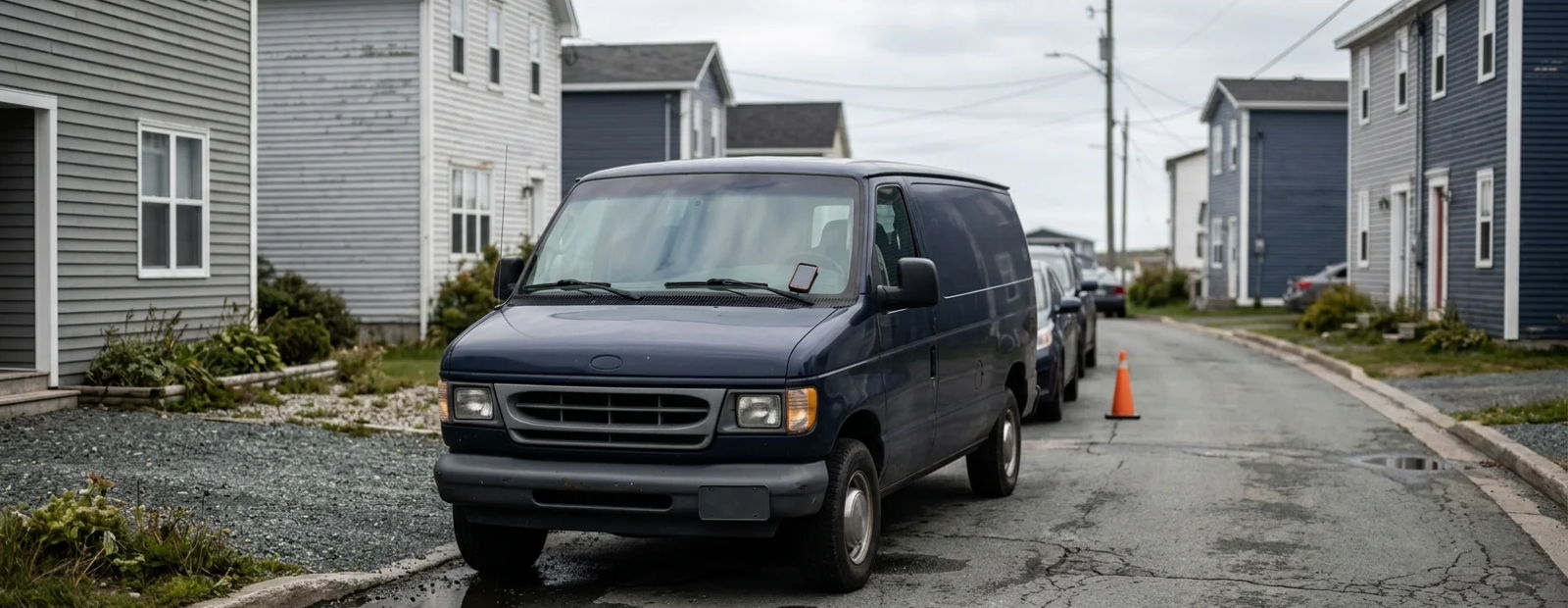
A missed call never shows up on a statement. There is no line item for it, no invoice, nothing in your bookkeeping that says you lost a job today. That is exactly why most trades owners in Halifax carry the cost for years without ever putting a number on it.
The short answer
Missed calls cost you your average job value multiplied by the number of callers who do not wait for you. Nobody can hand you that figure, because it depends on your trade, your prices, and how busy your week is. You work it out yourself with three numbers you already know: what a typical job is worth, how many calls go unanswered in a busy week, and roughly what share of those callers move on to the next name. Once you have that number, the fix is a choice between call forwarding, an answering service, missed-call text-back, or a front desk that answers every time.
Why missed calls are invisible
You know when a job goes sideways. You do not know when a call goes unanswered at 2:40 on a Tuesday while you are pulling a toilet.
The caller does not complain. They do not leave a voicemail telling you they went elsewhere. They just call the next name and you never hear from them again. The whole loss happens outside your view.
So the only way to see it is to work it out on paper, with your own numbers, once.
What do missed calls actually cost a Halifax trades business?
Grab three numbers. You already know all of them, roughly.
- Your average job value. Not your biggest job, not your smallest. What does a typical call turn into once it becomes work? Service call plus parts plus labour.
- How many calls you miss in a busy week. Check your call log on your phone for a week during a busy stretch. Count the incoming calls with no answer that were not spam and not your supplier.
- What share of those callers just move on. You will not know this exactly. Nobody does. Use your own judgment about how people behave when they need someone today.
Multiply the missed calls by the share who move on. That is roughly how many customers walked. Multiply that by your average job value. That is your weekly number. Multiply by however many busy weeks you have in a year.
A worked example, with made-up numbers
The numbers below are invented for illustration. They are not from a study and they are not from any real company. Use them only to see the shape of the calculation, then run yours.
Say average job value is $400. Say during a busy stretch you miss 10 calls a week. Say half of those callers do not wait for you.
That is 5 lost customers a week, at $400 each, which is $2,000 a week. Across 20 busy weeks in a year that is $40,000.
Change any of those three numbers and the answer moves a lot. If your average job is $1,200 because you do heat pump installs, the same 5 calls a week is a very different figure. If you only miss 3 calls a week, it shrinks. That is the point of running your own version instead of borrowing anyone else's percentage.
Why it is worse in the trades
Other businesses can afford to call people back. You often cannot, for three reasons.
Emergency calls do not wait. Water on the floor, no heat in February, a breaker that will not reset. Those callers need somebody now, not tomorrow morning.
People phone three companies at once. Standard behaviour for anything urgent. Whoever answers first gets the job, and the other two get nothing. It is not about who is better, it is about who picked up.
Weather bunches everything together. A storm rolls through or a cold snap sets in and the phone rings all day. That is precisely the day you are flat out and least able to answer it. Your busiest revenue day and your worst answer rate are the same day.
There is also the plain fact that your hands are full. A plumber under a sink cannot take a call. Neither can a roofer on a pitch in the wind, or an electrician with a panel open, or an HVAC tech in a crawlspace. Whatever your trade, the work itself is what stops you answering. You can see how this plays out across each one on the industries page.
The Halifax and HRM angle
HRM is spread out, and that spread costs you calls.
You take a job in Dartmouth, then the next one is in Bedford, then something comes in from Sackville. You are in the car for a good chunk of the day, and driving is when the phone rings most. Add the bridge at the wrong hour and a twenty minute hop turns into forty five.
Run out to the South Shore for a job and you have written off the better part of a day for one ticket, with your phone going the whole time. Add a stretch of poor signal on the way and some of those calls do not even register until you are back.
None of that is fixable by trying harder. The geography is the geography. What you can change is what happens when the phone rings and you are not there.
The fixes, in order of effort
Call forwarding
Cheapest and fastest. Send unanswered calls to your spouse, a subcontractor, or a second phone.
It works until the person on the other end is also busy, which in a small shop is most of the time. It also puts your business in the hands of whoever happens to answer, with no script and no calendar in front of them.
A real answering service
A person picks up and takes a message. Better than voicemail, and the caller hears a human.
The tradeoffs are real. It costs per call or per minute, and it adds up fast in a storm week. Most services take a message rather than book the job, so the caller still has to wait for you. And the person answering does not know your trade, your service area, or your prices. We compare the two side by side in AI receptionist vs answering service.
Missed-call text-back
Automatic text to anyone whose call you missed. Cheap, quick to set up, and it catches the caller before they dial the next company. We wrote up the details in Missed-Call Text-Back.
The limit is that it only fires after the call is already missed, and someone still has to answer the reply. It is a backstop, not a front desk.
The full AI front desk
The phone actually gets answered, every time, day or night. It talks to the caller, asks what the job is and where they are, checks your calendar, and books the job. Missed-call text-back sits underneath it for anyone who hangs up or texts instead.
That is what the AI front desk does, and the pillar post on what an AI front desk is walks through the mechanics. If you want to see it written for your trade, there are pages for plumbers, electricians, roofers and HVAC shops.
It is not magic. It will not diagnose a tricky job over the phone, and some callers can tell they are talking to software. What it does reliably is make sure nobody reaches dead air, and that the details land somewhere you can act on.
Questions, answered
How do I know how many calls I am actually missing?
Open your phone's call log and look back over one busy week. Count incoming calls with no answer, minus the spam and the supplier calls. That one look is usually enough to settle the argument.
Is voicemail really that bad?
Voicemail is a dead end for anyone finding you for the first time with a problem right now. It is fine for a customer who already knows you and is happy to wait. Someone with water on the floor is not going to wait, they will call the next name on the list.
Will an AI front desk sound wrong to my customers?
Some callers notice, and it is better to know that going in. What matters more to most of them is that somebody picked up, understood the problem, and gave them a time. Book a call and hear it for yourself before you decide.
What does it cost?
The Front Desk plan is $297 a month, no contract. That is the website, the AI front desk, and the review engine, all in. There is more on how these are usually priced in how much an AI receptionist costs, and the full breakdown is on pricing. If you later want ads, content and outreach on top, that is The Back Office.
Put a number on it, then fix it
Run your own arithmetic first. Then book a 15 minute call at /book. On the call we ring the front desk right there so you hear it handle a customer and book the job. Then you get a straight price, $297 a month, no contract.
Related Posts

How to Decide Which Jobs Your AI Front Desk Should Turn Down
The jobs you refuse shape your week as much as the ones you take. Here is how to decide which jobs your AI front desk should turn down, and the sentence it should say instead of yes.

Should an AI Receptionist Quote Prices Over the Phone?
Sooner or later a caller asks what it costs, and you have to decide whether your front desk is allowed to answer. Here is the honest breakdown for trades, job type by job type.
How Much Does an AI Receptionist Cost? (2026 Guide for Trades)
A plain breakdown of AI receptionist pricing models, what actually drives the price, what to watch for in a contract, and how to work out whether it pays for itself.