
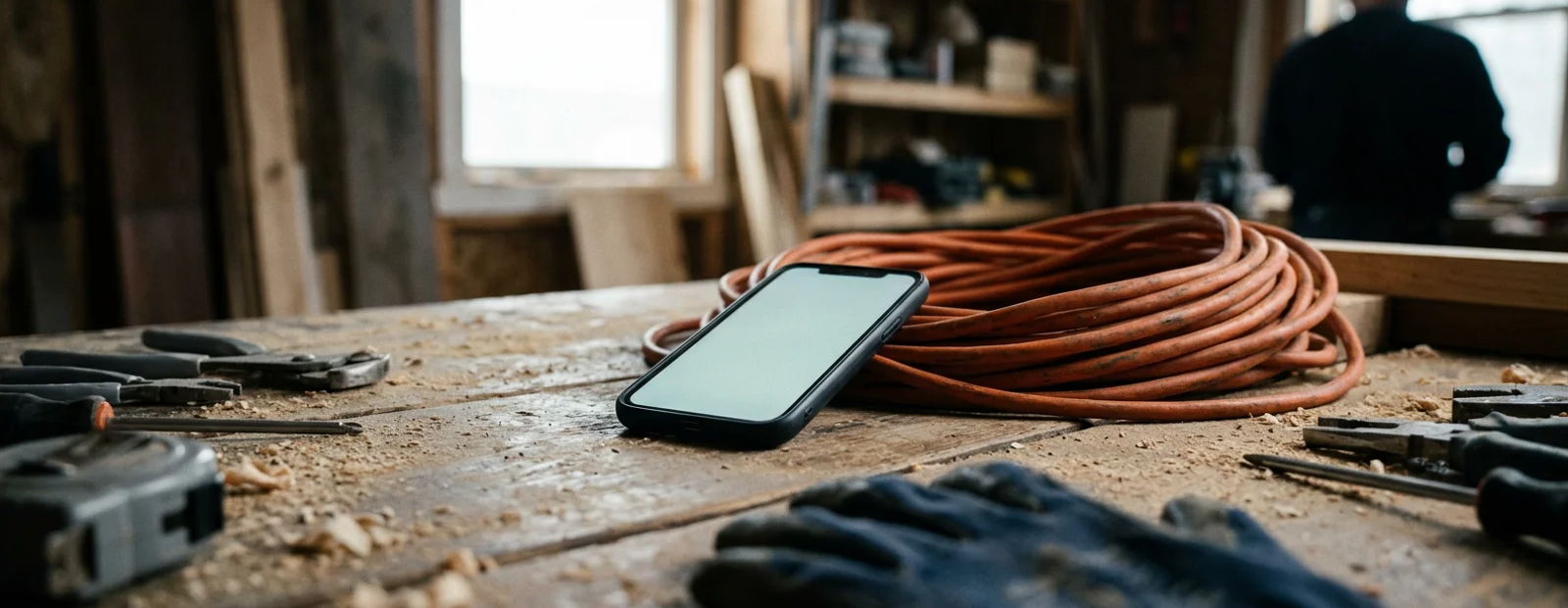
You are on a roof, under a sink, or driving between jobs. The phone rings and you cannot get to it. Missed-call text-back is the smallest fix for that moment, and it works because it does one thing well: it answers the person before they move on.
The short answer
Missed-call text-back is an automation on your business number that sends the caller a text the moment a call goes unanswered. To work, it has to fire in under a minute, come from the same number they just dialled, and give them one clear next step so they stop working down their list. It is a backstop, not a front desk: on its own it does not answer the phone, qualify the job, or put anything on your calendar. Pair it with someone or something that keeps the conversation going and it turns missed calls into booked work.
What is missed-call text-back?
It is an automation tied to your business number. When a call comes in and nobody picks up, the system sends that caller a text message. That is the whole mechanism.
It does not require a new phone, a new number, or a new app on your belt. Your existing number keeps ringing the way it always did. The text only fires when the ring goes unanswered.
Most people who reach a voicemail just call the next name on the list. A text lands differently. It is already open on the screen they are holding, and answering it takes five seconds instead of leaving a message and waiting.
What happens the second a call goes unanswered
Here is the sequence, step by step:
- Someone calls your number. It rings out, goes to voicemail, or you decline it because you are on a ladder.
- The system sees the missed call and grabs the caller's number.
- A text goes out from your business number, not a random one, so the caller recognizes who is texting.
- The caller replies by text. That reply lands somewhere you can see it, usually one shared inbox on your phone.
- The conversation continues by text until the job is booked or the caller says they are all set.
The important part is step 3. The text comes from the number they just dialled. If it arrives from a number they do not recognize, it reads like spam and gets ignored.
How fast it needs to go out
Under a minute. Ideally within about fifteen seconds of the missed call.
The reason is simple. A homeowner with a leak is working down a list. If your text arrives while they are still dialling the next company, you are back in the conversation. If it arrives twenty minutes later, someone else is already booked and you are the annoying follow-up.
Speed is the entire advantage of this feature. A slow missed-call text is barely better than a voicemail. If you want to see what those unanswered calls add up to over a year, read what missed calls cost Halifax trades.
What a good text says
Keep it short and human. Four things belong in it:
- Who you are, by business name.
- An acknowledgement that you missed them and why, in plain words.
- One question that moves things forward.
- A way to book without waiting for you.
Something like: "Hi, this is Dave at Dave's Plumbing. Sorry we missed your call, we are on a job right now. What is going on and where are you located? You can also grab a time here: [link]"
That is it. No pitch, no hours of operation, no list of services. The caller has a problem and wants to know if you can help.
How the conversation continues
Texting is not a one-shot message, it is a thread. Once they reply, you need someone or something to keep answering.
That is where a lot of setups fall apart. The text goes out, the customer replies "burst pipe in Bedford, can you come today," and then nothing happens for two hours because you are still under a sink. You bought yourself a reply and then dropped it.
The fix is either a real person watching one inbox, or an AI front desk that reads the reply, asks the follow-up questions, checks your calendar, and books the job. If you want the full picture of how that works, read what an AI front desk is.
Common mistakes
These are the ones we see most often on trades numbers.
- Sounding like a robot. "Your call is important to us" is worse than saying nothing. Write it the way you would text a customer yourself.
- No clear next step. A text that says "we will get back to you" gives the caller nothing to do, so they go back to their list.
- No booking link. If they have to wait for you to be free, you have just recreated voicemail with extra steps.
- Texting a landline. Some business numbers cannot send SMS. That needs to be sorted before any of this works.
- Nobody watching the replies. The single biggest one. A text-back with no follow-through burns the lead and looks worse than silence.
- Firing on every call. If your buddy calls twice, he does not need two texts. Sensible rules matter.
Where it stops
Missed-call text-back is a patch, not a front desk. It catches the call after you have already lost it.
It does not answer the phone. It does not talk to the caller who will not text, and plenty of older customers will not. It does not qualify the job, quote a rough price, or put anything on your calendar by itself. It does not handle the after-hours emergency call where somebody wants a voice.
That is the honest limit. It is a good limit to know, because it tells you what to build next.
How it fits inside the full AI front desk
We include missed-call text-back in the AI front desk, but it is the backstop, not the main event. The main event is that the phone actually gets answered.
The AI front desk picks up, speaks to the caller, asks what the job is and where they are, and books it into your calendar. If the caller hangs up before it connects, or texts instead of calling, the text-back catches them. Two layers, same customer.
Every trade sets it up a little differently. Plumbing shops can see how we handle it on AI receptionist for plumbers, and heating and cooling shops on AI front desk for HVAC.
You can hear it handle a call on the demo page. It is all part of The Front Desk plan, which is a website, the AI front desk, and an automated review engine for $297 a month with no contract. Full details are on pricing.
Questions, answered
Will customers find the text annoying?
Very few do, as long as it arrives fast, comes from your number, and sounds like a person. The complaints come from texts that arrive an hour late or read like a form letter.
Do I need a new phone number?
No. It runs on your existing business number as long as that number can send and receive texts. If it is a landline, that gets sorted during setup.
What if someone replies and I am on a job?
That is exactly the case the AI front desk covers. It reads the reply, asks the next question, and books the job while you keep working. Without that, someone has to be watching the inbox.
Can I just do this myself with a phone app?
You can, and some owners do. The tradeoff is that a basic app only sends the first text. Everything after that, the questions, the scheduling, the follow-up if they go quiet, is still on you.
See it work on your own number
Book a 15 minute call at /book. On the call we ring the front desk right there so you hear it handle a customer and book the job. Then you get a straight price, $297 a month, no contract.
Related Posts

How to Decide Which Jobs Your AI Front Desk Should Turn Down
The jobs you refuse shape your week as much as the ones you take. Here is how to decide which jobs your AI front desk should turn down, and the sentence it should say instead of yes.

Should an AI Receptionist Quote Prices Over the Phone?
Sooner or later a caller asks what it costs, and you have to decide whether your front desk is allowed to answer. Here is the honest breakdown for trades, job type by job type.
How Much Does an AI Receptionist Cost? (2026 Guide for Trades)
A plain breakdown of AI receptionist pricing models, what actually drives the price, what to watch for in a contract, and how to work out whether it pays for itself.